
Send a message
Send us a message and we will get back to you as soon as possible.
The team behind Mul10 ProSafe
Contact specific employees on the details below




Frequently asked questions

Fall protection must be used when working at height against falling from roofs - when there is more than 3.5 meters from the edge of the roof to the ground. Employees working and walking less than two meters from the edge of the roof must be secured against falling.
If the free fall height is between 2-3.5 m, a risk assessment must be carried out by the employer to determine whether fall protection is necessary. Fall protection must be used if it is deemed that a fall will result in serious injury.
A fall protection kit is a complete solution that keeps you safe when working at height. It typically consists of a safety harness, a fall arrest device, a carabiner, and often a connecting link or a lanyard. Together, these components form a system that will safely catch you if you lose your balance while working.
While the fixed anchoring system on the roof is a permanent solution, the fall protection kit is the equipment you wear and carry with you during your daily work. The kit is connected to an anchor point on the roof—for example, our anchor point—and only then are you truly secured.
Yes. All components of the Mul10 ProSafe are CE-marked and comply with the applicable fall protection standards: DS/EN 795:2012 (anchor devices), DS/CEN/TS 16415:2013 (multiple users simultaneously), DS/EN 362 (connectors), DS/EN 363 (fall protection systems), DS/EN 364 (test methods), and DS/EN 365 (use, maintenance, and inspection). The system has been tested and approved in collaboration with the Danish Technological Institute using both static and dynamic drop tests, and the safety foot is approved for two users at the same time.
Fall protection is also required for short tasks. It is the height and the risk of falling that determines it, not how long you are on the roof. If you just need to check a gutter or replace a single panel at a height of 3 meters, the protection must still be in place before you go up there. Many accidents happen precisely during quick tasks, where fall protection is not chosen because the task seems too small to be worth the effort.
Before using fall protection equipment, the user must ensure that it is complete and functional. In addition, check if the equipment has undergone an inspection within the last 12 months. Equipment must not be used if it has been used to stop a fall or if there is any doubt about the suitability of the equipment before it has been inspected. Defects and deficiencies must be reported to the employer.
The components of a fall protection kit must always be compatible with one another and tested to function as a single system. For this reason, we recommend purchasing a complete kit, rather than assembling one from individual parts from different manufacturers. This ensures that the harness, fall arrest device, and carabiner are compatible and meet the same safety standards.
We manufacture and deliver Mul10 ProSafe throughout Denmark from our own factory in Klakring near Juelsminde. The installation itself is carried out by certified Mul10 ProSafe installers—typically roofers, whom we train and certify. We’d be happy to refer you to a certified installer, or you can have your own employee certified.
The rules for fall protection also apply to pitched roofs, just as they do to flat roofs, but the limits are different. On a pitched roof with a slope of more than 15 degrees, there must be protection from a height of 5 meters, while the requirement for flat roofs already applies from 2 meters. Below these limits, a risk assessment must still be made so that you know whether additional protection is needed anyway.
According to EN 795:2012, anchor points for fall protection must be able to absorb a force of 12 kN (1200 kg) from one person. An anchor point is approved by performing both a static test and a dynamic drop test, as described in EN 795:2012. The Mul10 ProSafe Single Eye Safety Foot has been tested and approved for 2 users at the same time (including a static test of 13 kN).
A fall protection kit must be inspected at least once a year by a qualified person who can assess whether the equipment is still safe to use. In addition to the annual inspection, you are responsible for checking the equipment for wear and damage every time you use it, so that you can identify any problems in a timely manner.
A permanently installed fall protection system must be inspected at least once a year. The inspection itself is performed by a certified Mul10 ProSafe installer—not by us directly. We define the inspection procedure and train the installers, so you can either become certified and perform the inspection yourself or have it performed by a certified installer. The inspection includes, among other things, checking and tightening the wire, inspecting fittings, sliders, and safety feet, as well as performing a tensile test on at least every 10th safety foot.
For fall protection on flat roofs, use Mul10 ProSafe's fall protection - a system with posts that you attach yourself to. The system is patented, and the posts can be placed up to 10 meters apart. It is waterproof, so it does not create leaks in the roof, and the anchorage is made of stainless steel AISI 316, tested by the Danish Technological Institute.
Fall protection equipment must be CE marked and approved according to applicable European standards. All fall protection equipment must be inspected at least once a year by a competent professional.
Fall protection equipment may be worn for a maximum of 4 man-hours.
A fall protection kit must be replaced immediately if it has been dropped, even if there is no visible damage. The forces from a fall can weaken the material from the inside, without any visible signs on the outside. The same applies if you notice wear, cracks, or other signs of weakening, both during routine inspections and during the annual inspection.
Mul10 ProSafe is a permanent fall protection system that is installed in the roof structure—developed specifically for roof work on bitumen and PVC foil roofs made of concrete, steel, and plywood. For work from a lift or scaffold, other solutions are used; in these cases, the lift and scaffold themselves serve as alternatives to permanent fall protection. If you’re unsure about what your project requires, we’d be happy to advise you.
A roof fall arrest kit should at least include a harness, a fall arrester, a carabiner and a line or connector that is tested and CE marked. In addition to the kit itself, as an employer you should also have a contingency plan ready so that you know how to get someone down safely if an accident occurs.
Fall arrest means moving straight out from the anchor point and adjusting the line so you can't fall out.
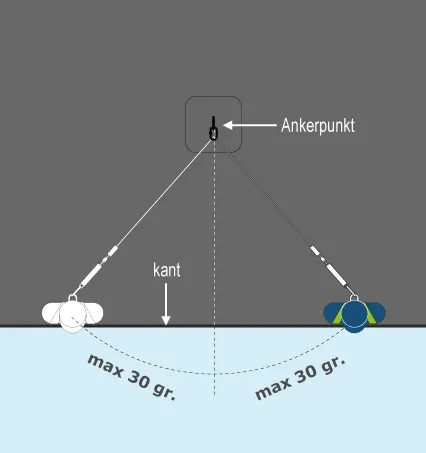
Fall-absorbing fall protection extends from its anchor point, so there will be a risk of falling and swaying. It should be equipped with a fall arrestor that absorbs the force of the fall.
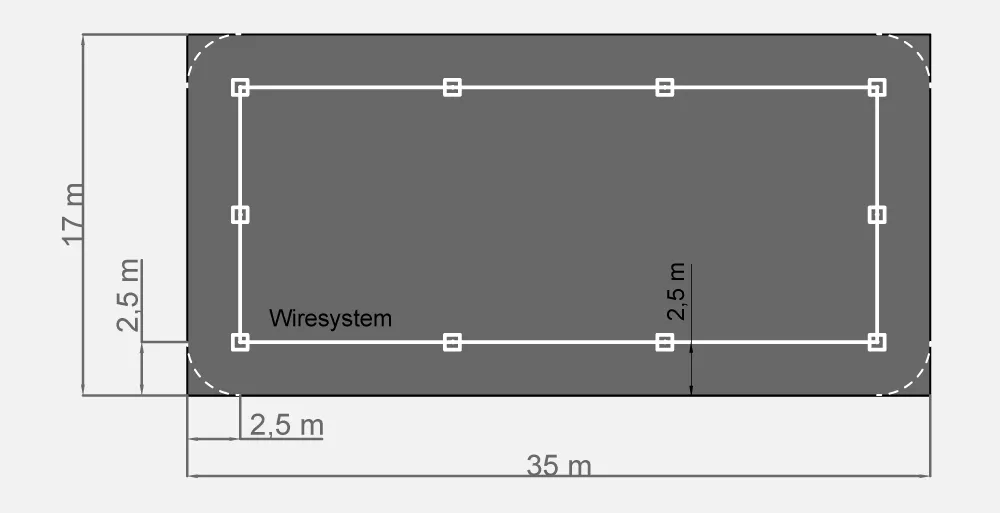
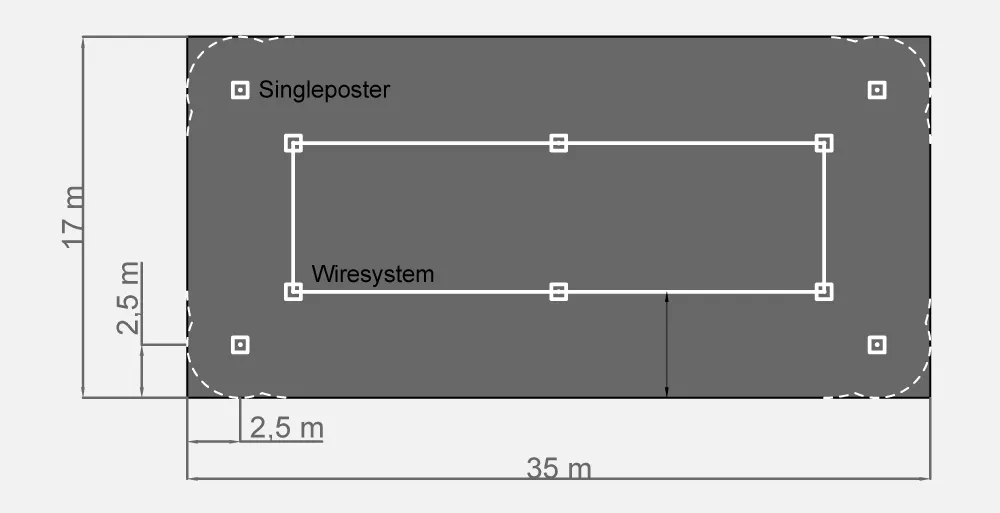
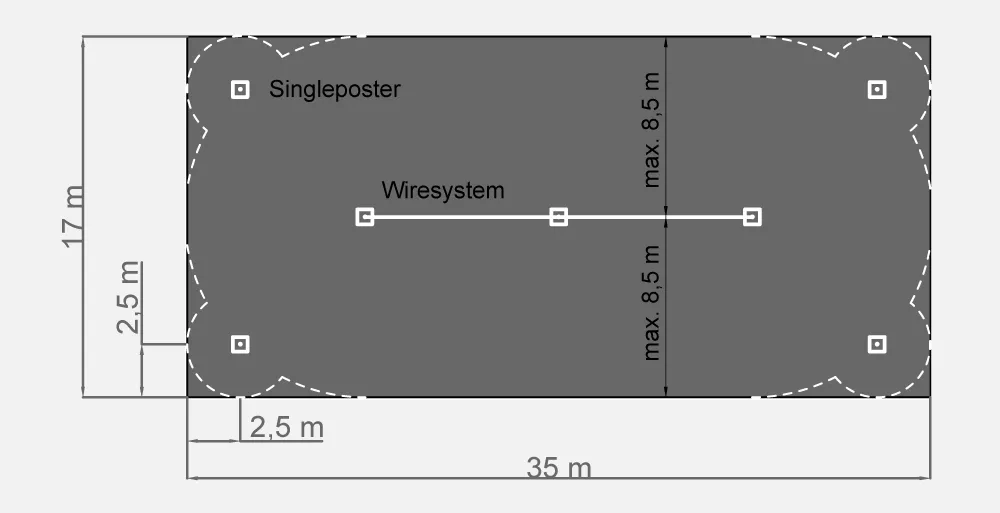
The examples below illustrate some fall protection solutions. When you move inside the dotted lines and have adjusted your line, it will prevent falls. As soon as you move outside the dotted lines, you risk pendulation..
You must receive training before using a fall arrest system—even if you already have experience with roof work. Proper use requires that you understand how to set up the equipment correctly and how it works in the event of an accident. Therefore, take the time to familiarize yourself thoroughly with the equipment before using it on the roof.
You will become certified by completing our fall protection course. Here, you will learn how to properly install and inspect the Mul10 ProSafe system, and you will be registered as a certified Mul10 ProSafe installer. As a certified installer, you are authorized to both install the system and perform the annual inspections required by law. The course is intended primarily for roofers.
Contact us at +4576830101 or info@mul10prosafe.dk for upcoming dates and registration.
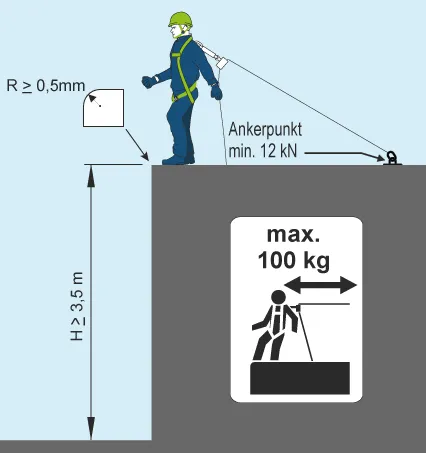
There must be clearance ("H") below the user (at least 3.5 m) that will allow for safe fall arrest. The maximum weight of a user must not exceed 100 kg. The anchorage point or hooked wire must not be below the user's foot level. The radius of the edge must be at least 0.5 mm. If the edge of the roof is sharp, there is a high risk of damage to the rope, so it must be fitted with a suitable guard.
NOTE: Calculation of stopping length and safety distance must always be based on the manufacturer's information in the user manual.
With adjustable line
Stopping length = Person length + fall arrest device
With fastline of max 2 meters
Stopping length = Line length + Person length + Safety margin (1 meter)
If you move too far to the sides, relative to the anchor point, and fall over the edge, you will "oscillate" and risk hitting vertical structures, or in the worst case scenario - hit the ground or the floor below. You will fall several meters before the fall arrest effect kicks in. To avoid this, you should move at a maximum angle of 30 degrees from the anchor point.
Sign up for our newsletter
and get updated on new products, regulations, prices and more.

